If you are planning a wall for a sloped lot, retaining wall cost is probably the first thing on your mind. So how much does a retaining wall cost? The honest answer is that it depends.
A short garden wall and a tall engineered wall are different projects with very different prices. In the foothills, the terrain adds another layer, since steep lots and rocky soil make the work harder than it would be on flat ground.
So when homeowners ask how much a retaining wall costs, the real question is what the wall has to do.
Here is what drives the price, and why two walls of the same length can land at very different numbers.
Why Retaining Wall Cost Varies So Much
There is no flat rate for a retaining wall. The price tracks the work behind it.
A low wall that borders a planting bed holds back very little soil and needs little structure. A tall wall holding back a hillside carries enormous pressure and needs real engineering to stay standing. Every factor below pushes the cost in one direction or the other.
Once you understand them, a quote stops feeling like a mystery and starts to make sense.
Wall Height Is the Biggest Factor
Height affects price more than any other single thing. The taller a wall gets, the more soil pressure it has to resist. That calls for a wider base, more reinforcement, and often a stronger material. Short walls under a few feet are usually straightforward.
Once a wall passes roughly three to four feet, it typically needs engineered plans and inspection, which adds both cost and time. A wall twice as tall is rarely twice the price. It often costs far more, because the structure behind it grows quickly with every added foot.
Engineering and Permits Add to the Total
Taller or load-bearing walls need an engineer to design them. The engineered plans account for soil, drainage, and the exact loads the wall will face. This step costs money, but it is what keeps the wall from failing down the line. Permits follow the same logic.
Most areas require a permit once a wall reaches a set height or holds a surcharge like a driveway above it.
We handle permitting, inspection, and engineering across our projects, so these steps are managed rather than left to the homeowner. They still factor into the retaining wall cost, so it helps to expect them from the start.
Slope and Site Access in the Foothills
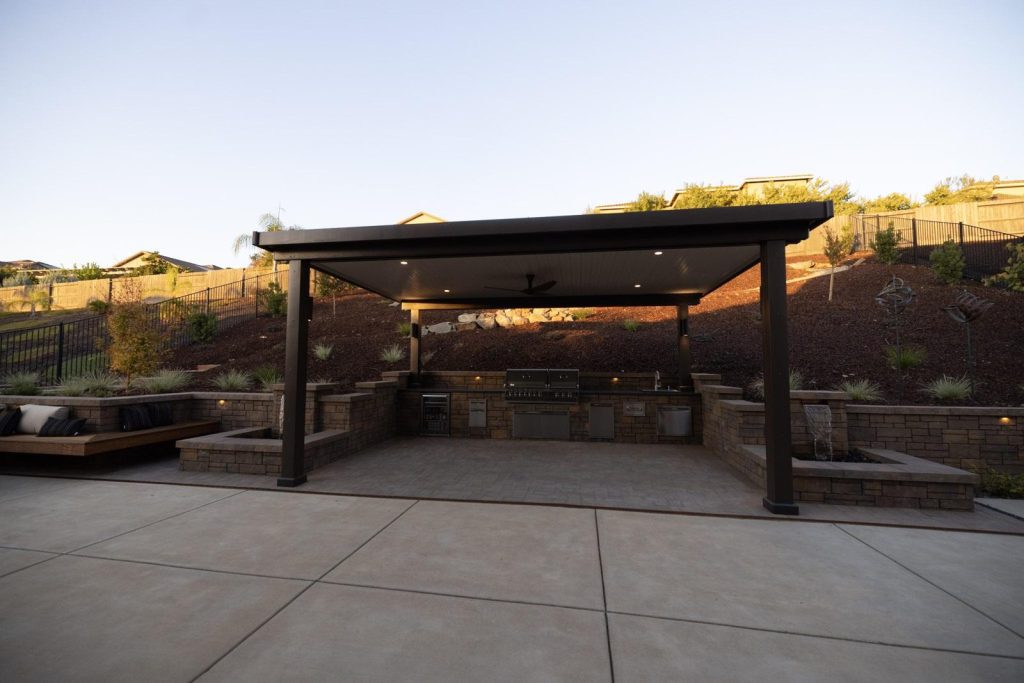
This is where foothill lots get expensive. A steep or rocky site is harder to build on than a flat one. Crews may need extra excavation, more grading, and sometimes rock removal before the wall can begin. Access matters just as much.
If machinery and materials cannot reach the work area easily, the job takes more labor and more time. Two identical walls can carry very different prices based on how reachable the site is. On El Dorado County properties, this one factor can shift a quote noticeably.
Wall Length and Soil Conditions
Length and height together set the size of the wall, and most quotes come down to the square footage of the wall face. A longer wall uses more material and more labor, so the total climbs with every linear foot. Soil plays a quieter but real role.
Foothill lots often sit on rocky ground or expansive clay that shifts with moisture. That kind of soil can call for a deeper base or a stronger footing, which adds to the cost while keeping the wall stable for the long run.
A soil check during planning is cheap insurance against surprises once the digging starts.
A Realistic Price Range
There is no single price for a retaining wall, but a few general ranges help set expectations.
Across the industry, an installed wall tends to run about $20 to $40 per square foot of wall face for segmental block, $30 to $55 for poured concrete, and $40 to $75 or more for natural stone.
For a standard residential wall, that often puts the total between $5,000 and $15,000. Taller engineered walls on steep foothill lots can climb past that, into the $20,000 to $50,000 range once engineering and difficult access are factored in. California labor sits on the higher side of these figures.
Treat them as starting points, since the specifics of your lot move the final number in either direction.
Materials and Drainage
The type of wall and the material both set the baseline for the cost to install a retaining wall.
Here is roughly how the common materials compare on price.
| Material | Relative Cost | Best Suited For |
|---|---|---|
| Segmental concrete block | Lower | Most residential walls, curves, efficient builds |
| Poured concrete | Moderate | Structural walls that need a solid, formed face |
| Natural stone | Higher | High-end, design-focused walls |
Finishes move the number too, since a capped, textured, or veneered wall costs more than a plain block face. Drainage then adds to the build on every wall worth doing. Weep holes, a perforated drain pipe, and gravel backfill give water a way out from behind the wall.
Good drainage is the difference between a wall that lasts for decades and one that bulges or fails, so it is never the place to cut corners.
What Retaining Wall Installation Cost Usually Includes
A fair quote covers more than the blocks you see. Retaining wall installation cost generally includes:
-
Site prep and excavation to clear and shape the area
-
Base material and compaction for the wall to sit on
-
The wall structure itself, including any reinforcement
-
Drainage, such as weep holes, drain pipe, and gravel backfill
-
Backfill, cleanup, and grading around the finished wall
-
Engineering and permit fees where the wall requires them
When you compare bids, make sure each one covers the same scope. A low number that skips drainage or proper base work is not a saving. It is a repair waiting to happen, which is why choosing the right contractor matters as much as the price itself.
Ways to Manage the Cost
A few choices can bring a retaining wall cost down without weakening the result.
On a tall slope, two shorter terraced walls can sometimes replace one tall engineered wall, which may lower the structural requirements and soften the look at the same time. Keeping a wall under the height that triggers engineering, where the site allows it, avoids added design fees.
Choosing block over natural stone saves on material without giving up strength. Improving access before the crew arrives, such as clearing a path for equipment, can trim labor hours on a tight lot. None of these should come at the expense of drainage or a solid base, since those are what make the wall last.
The goal is a lower price, not a shorter lifespan.
Getting an Accurate Number for Your Property
The only way to know your real retaining wall cost is a look at the site. The cost to install retaining wall work depends on height, soil, slope, access, and material, all of which land differently on every lot. That is why a single online figure rarely fits.
A walk of the property gives the accurate picture that a generic estimate cannot. A retaining wall often works alongside the patios and planting around it as part of a larger hardscape project, and a site visit can account for how it all fits together.
For a clear number on your retaining wall, reach Hughes Landscape at (916) 209-0298 or info@hugheslandscape.co.